The Son Doong discovery is one of the most remarkable cave stories in modern exploration. Hidden deep within Vietnam’s Phong Nha–Ke Bang National Park, Son Doong remained untouched by science until recent decades. Today, it is famous as the world’s largest cave passage, attracting explorers, scientists, and filmmakers from around the globe.
Explore the discovery of Son Doong Cave helps travelers appreciate the cave’s value and fragility. At the same time, it highlights why careful planning and responsible tourism are essential. Vietpower Travel supports travelers by offering research-based information, detailed preparation guidance, and responsible tour arrangements for the region.
People wonder Why was Son Doong unknown for so long? The cave is hidden deep in dense jungle with no visible landmark from above. Its entrance is steep and covered by thick vegetation, making it extremely difficult to locate. This section will introduce the background and significance of the Son Doong discovery.
The story begins around 1991, when a local man named Ho Khanh was walking through the dense jungle in search of agarwood. He came across a deep opening in a limestone cliff. A strong wind roared from the darkness, carrying mist and the sound of rushing water. Although he could not enter safely at that time, the experience stayed with him.
Years later, during the early 2000s, Ho Khanh guided members of the British Cave Research Association through the forest. For a long time, he could not relocate the entrance.
However, in 2008 he finally rediscovered it and led the British team back. In 2009, the formal exploration began, led by speleologists Howard and Deb Limbert. Their survey confirmed what no one had imagined: Son Doong contained the largest cave passage on Earth.
This moment transformed Son Doong from a hidden opening in the jungle into a global geological wonder.
.jpg)
When the first maps and photographs were released in 2010, the international media took notice. Dramatic skylights, towering cave walls, and underground jungles made headlines. Soon, researchers, organizations, and major media producers began planning expeditions to capture its beauty and study its environment.
This rise in global attention also brought a responsibility to protect the cave. Managing tourism pressure and supporting scientific work became essential parts of the region’s development strategy.
Exploring Son Doong Cave is one of the most extraordinary adventures on Earth. This massive underground world challenges imagination with its towering chambers, ancient formations, and its own subterranean jungle. You can find all information you need in this post of Vietpower Travel!
Following its discovery, Son Doong quickly attracted attention from major international media. Documentary teams recognized that the cave offered visuals rarely seen anywhere on Earth
After the Son Doong discovery was confirmed, documentary teams and major media networks began planning expeditions. The BBC filmed inside the cave for several large productions, including Planet Earth III. Their team spent weeks in the cave system and carried more than a ton of equipment to capture rare lighting effects and the cave’s immense chambers.
Another milestone came in 2015, when National Geographic created a pioneering 360-degree virtual tour of Son Doong. This project allowed audiences everywhere to explore the cave virtually. ABC’s Good Morning America also filmed a special broadcast from Phong Nha, drawing global attention.
These productions introduced Son Doong to millions of viewers. They showcased its beauty and helped spread awareness of the need for strict conservation.
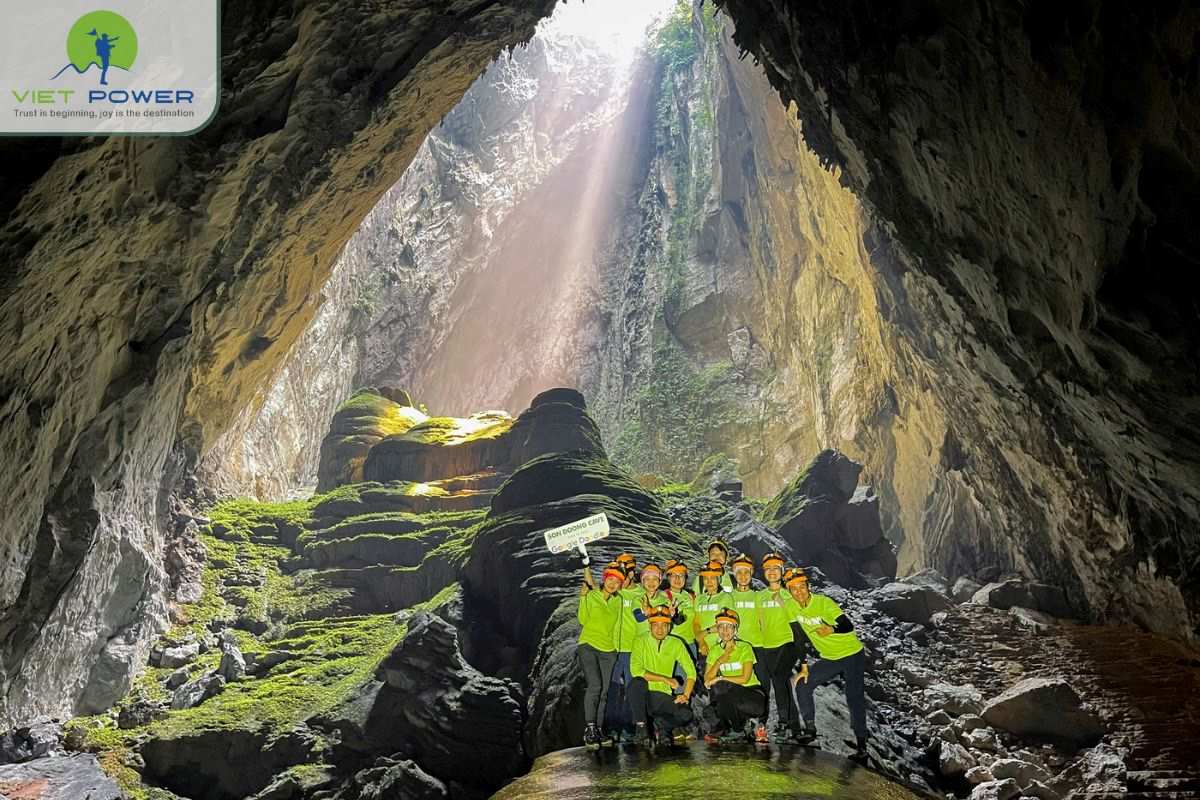
Did you know filming inside Son Doong was so challenging? The cave’s chambers are so large that they can fit skyscrapers. As a result, traditional lighting does not work. Crews must bring powerful lamps, heavy batteries, and long cable systems. Every sequence requires planning, teamwork, and careful handling to avoid damaging fragile formations.
National Geographic’s 360-degree project demanded new techniques. Photographers stitched together gigapixel images and used long exposures to capture details in low light. Even simple movements, such as crossing underground rivers, demanded safety planning and teamwork.
Because Son Doong is fragile, film crews must follow strict environmental rules. They work closely with cave experts and conservation officers to ensure that filming leaves no lasting impact. These efforts highlight both the beauty and the sensitivity of the cave environment.
Discover more posts on the same topic and dive deeper into Vietnam’s beauty, culture, and landmarks. Explore our Vietnam tourist attractions category to find new destinations worth adding to your travel list.
Beyond its dramatic appearance, Son Doong is an important natural laboratory. Scientists from various disciplines study its geology, water systems, and living organisms.
Since 2009, Son Doong has become a significant site for geological research. Scientists study how the cave formed, the age of its limestone layers, and the processes that shaped its massive chambers. Collapsed dolines, which allow sunlight to reach the cave floor, are of particular interest. They reveal how erosion and climate have influenced the cave over millions of years.
Hydrologists also investigate the underground river that flows through the cave. Some areas require cave diving to explore, and several submerged passages remain only partly surveyed. Researchers try to understand how these water systems connect to neighboring caves, such as Hang En.
.jpg)
Fact: The underground river in Phong Nha Cave is one of Asia’s longest: Stretching over 13 kilometers, the river flows deep into the mountain. Only a portion is open to tourists, while the rest requires expert-level expedition skills. These studies provide valuable insight into the evolution of Vietnam’s karst landscapes.
Continue exploring similar posts to learn more about Vietnam’s diverse landscapes and ecosystems:
Son Doong is also a biological treasure. Although light is limited, certain sections support unusual ecosystems. Under the dolines, large trees, ferns, and shrubs grow in a unique microclimate. Scientists have recorded multiple bat species, insects, and other cave-adapted organisms.
Recent biodiversity surveys in and around the cave have identified new species and updated records for existing ones. These findings highlight how little is known about the cave’s full ecological diversity. Each new survey brings fresh insights into life that thrives in darkness.
.jpg)
Do you know the ecosystem around the caves holds many new species? Phong Nha – Ke Bang is famous among scientists because dozens of new plant and insect species were discovered in the park in the last decade. Some of them exist only in the limestone environment of these caves
Researchers also monitor human impact on Son Doong Cave. Tourism must be controlled because small disturbances can damage fragile rock formations or affect wildlife. Studies evaluate the effects of foot traffic, artificial light, campsite positions, and visitor numbers.
Their data helps park authorities and tour operators maintain strict guidelines. These measures ensure that scientific research can continue and that the cave remains pristine for future generations.
Let Vietpower Travel transform your curiosity about Vietnam into a customized adventure made just for you.
Even after more than a decade of research, Son Doong continues to reveal new discoveries. Each expedition adds information about the cave’s structure and biodiversity.
People wonder: Are new areas of Son Doong Cave still being explored? Yes. Explorers continue to push deeper into the cave system. In 2019, cave divers reached submerged passages leading to new tunnels. They discovered a section that descends below sea level, suggesting that the cave may be even larger than previously measured. Some areas remain unexplored due to diving limits.
.jpg)
Fact: Son Doong Cave physically connected to Hang En. Evidence suggests possible links to nearby systems like Hang En. Some submerged passages hint at deeper connections, but full mapping is still incomplete.
These discoveries inspire further scientific interest. They also remind us that Son Doong Cave still holds secrets beneath its enormous chambers.
Discover more posts on the same topic to deepen your appreciation of Vietnam’s nature:
Son Doong’s biological richness continues to surprise researchers. In early 2025, a team from the Vietnam National Museum of Nature reported a new land-snail species found inside the cave. This species represents a new entry for Vietnam’s fauna and adds to the growing list of organisms recorded in the region.
.jpg)
Other biodiversity surveys conducted between 2022 and 2024 documented additional insects, invertebrates, and updated bat species lists. These findings broaden our understanding of life in extreme environments.
Do you Know “Hang En”- one of the most captivating natural wonders in Phong Nha–Ke Bang National Park means “Swift Cave,” named after the swifts and swallows that live inside.
Why does the mapping of Son Doong Cave matter? Because of Son Doong cave’s immense scale and complex internal structure, it requires careful mapping and regulated access.
Recent technological efforts have improved digital maps of Son Doong. Updated 3D models support scientific analysis and help guide safe travel routes. They also provide conservation teams with tools to monitor changes in cave structure or vegetation over time.
Digital mapping allows researchers to return to the same areas without physical impact. It also helps tourism planners design low-impact travel routes.
The Son Doong discovery represents one of the greatest modern exploration achievements. From a local forest encounter in 1990 to a globally recognized scientific wonder, its story continues to inspire adventure seekers and researchers. Understanding its discovery, documenting efforts, scientific studies, and recent findings gives travelers a deeper appreciation of its value.
If you are ready to explore the wonders of Phong Nha–Ke Bang and learn more about the world’s largest cave system, contact us today. Let Vietpowder Travel help you plan a safe, meaningful, and exceptional adventure.
Please kindly send us your ideas about the tours: destinations, attractions, your group, hotel class... we will get back to you with details & best offers quickly. Surely, you will feel satisfactory!
 |
 |
 |
 |
 |
 |

.jpg) Customize Your Trip
Customize Your Trip
 Vietnam
 Thailand
 Laos
Laos Indonesia
 Cambodia
 Myanmar
 Indochina Tours